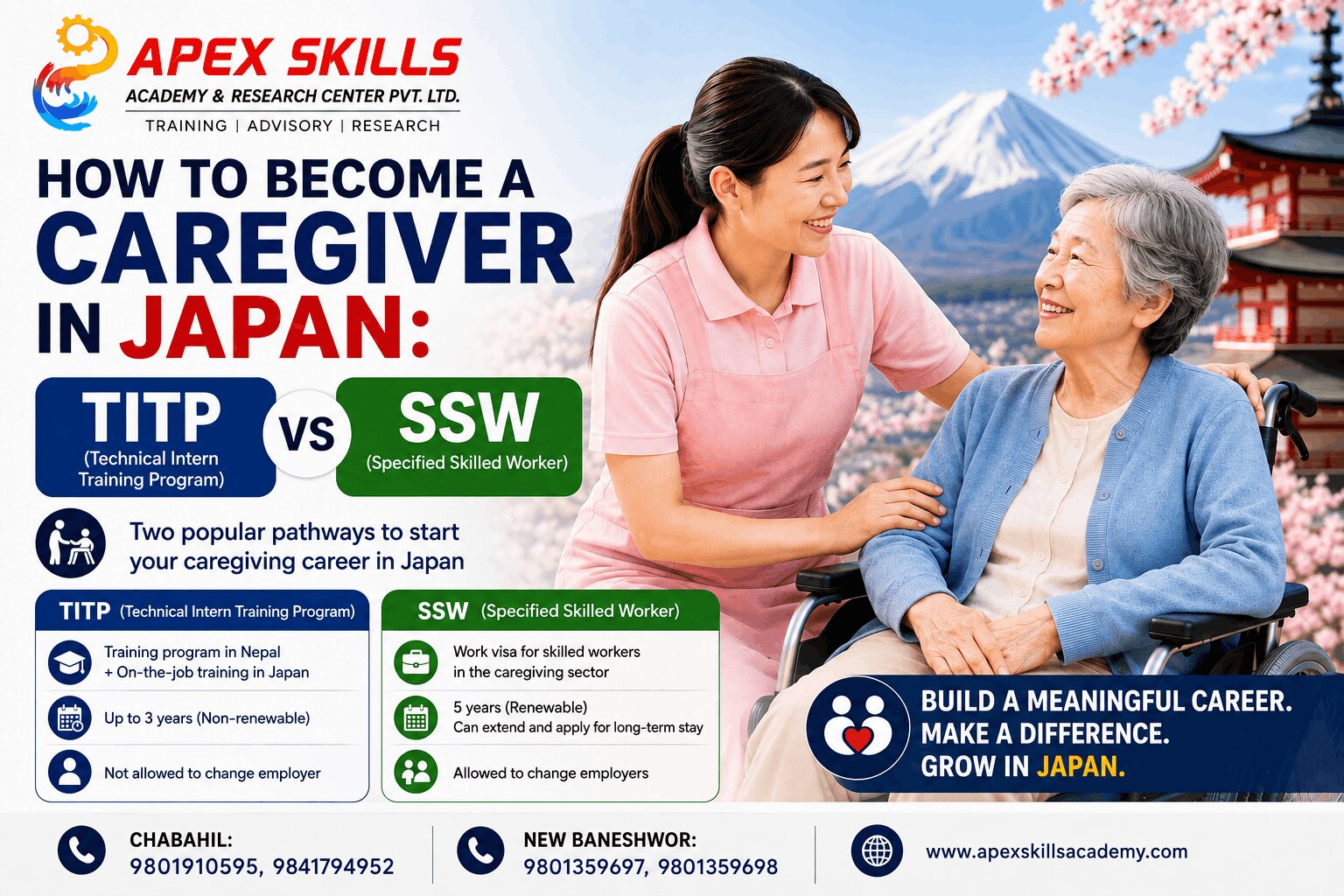
The number of people who have a number of opinions and answers about TITP and SSW is high; most of them would be wrong, some would be outdated, and barely one would be right about it. That is the main problem with this topic for anyone who is trying to land the caregiving job in Japan. It is not that the information does not exist; it is that most of the information about it floating around Kathmandu is either half-remembered or half-true.
So, here is the actual comparison about it for the applicants from Nepal: the requirements and the criteria as they stand in the present, and one change that is coming to Japan’s system that will affect anyone planning to leave in the next two years.
What is TTIP?
TTIP, in general terms, is the Technical Intern Training Program that has been running since 1993. On paper, it is a skills transfer scheme: when you go to Japan, a company trains you, and you bring that experience home. In practice, for more than three decades it has been fully functional as Japan’s main channel for foreign labor in sectors that could not fill the position locally, a caregiver among them.
The entry bar is low. You do not need any prior work experience or advanced Japanese to get in, which is exactly why it has been the default starting point for so many Nepali applicants. You are placed with one employer for the length of your contract, typically building up to five years; you are expected to go home when the contract ends. Changing employers’ mid-program is almost never allowed, only in some rare cases like some mishap- or proven-abuse-related situations.
That is one single detail: being blocked by the employer is the major and the root of the most TITP complaints you’ll hear from the returners. If the workplace is fine, the program is fine, and if it is not fine, then you will have very little room to move.
What is SSW?
SSW, Specified Skilled Worker (Tokutei Ginou), is a program that was launched in April 2019 as Japan’s direct answer to the labor shortage that TITP alone could not cover. It comes in two tiers: SSW Type 1 and SSW Type 2. In Type 1, almost everyone starts with a straightforward visa, which is tied to their work sector, which is renewable and capped at five years total. Whereas in Type 2, it is for those people who have moved into the supervisory or the advanced roles, and it opens the door to bringing family and staying indefinitely, something that Type 1 does not allow.
The actual difference between these two is that SSW workers are employees, not the trainees. The wages must match the same or beat what a Japanese worker doing the same job in the same region earns, and you are legally free to switch employers within the same field without needing anyone’s permission, provided that the new employer is a registered SSW-accepting organization. But doing the same on TITP is not allowed; you might get deported back to your home country.
By early 2026, roughly more than 350,000 people who were working in Japan are under the status SSW, against a government target of about 820,000 by 2029. Caregiving is one of the sixteen approved SSW sectors, and Nepal is one of the recognized sending countries feeding that pipeline, alongside with Vietnam, Indonesia, and the Philippines.
TITP vs. SSW at a glance
|
Category |
TITP |
SSW (Type 1) |
|
Purpose (official) |
Skills transfer / international cooperation |
Filling labor shortages |
|
Japanese level to enter |
No fixed minimum |
JLPT N4 or JFT-Basic |
|
Extra caregiving requirement |
None to enter |
Nursing Care Skills Test + Nursing Care Japanese Test |
|
Max stay |
Up to 5 years |
Up to 5 years (Type 1), longer via Type 2 |
|
Can you change employers? |
Essentially no |
Yes, within the same sector |
|
Wage protection |
Not guaranteed to match local rate |
Must match or exceed local market rate |
|
Family allowed |
No |
No on Type 1, yes on Type 2 |
|
Path to settle long-term |
Not directly |
Yes, via Type 2 or the Kaigo (licensed care worker) status. |
|
Who it suits |
First-time applicants with no prior training or experience |
Applicants who've cleared the language and skills tests or completed TITP already |
The part where most blogs haven’t updated about this topic yet
The TTIP program is about to be retired. The Japanese government passed legislation in 2024 to replace it with a new framework called Employment for Skilled Development, known in Japanese as IKusei Shuro. Official guidelines were only finalized in early 2026. The new plan is for the new system to start in 2027, with the last group of TITP entrants going in around mid-2027 before the old program gets completely closed for good.
The actual reason and logic behind this switch is worth knowing, even if the mechanics are still being worked out. IKusei Shuro drops the “training, not labor” with a structured three-year runway into SSW Type 1. Employers will reportedly be required to fund a minimum block of Japanese language instruction early in the contract, and the new system is expected to cap total intake at roughly 425,000 workers for its first two flowers, a deliberate move toward controlled, outcome-based migration rather than open-ended intake.
If you are planning your Japan timeline around early 2026-2027, this matters. Anyone entering under old-styled TITP close to the cutoff may find themselves navigating a transition rather than a clean five-year program. Talk to your training institute about which side of the line your application will fall before you commit to it.
What the SSW caregiving route actually requires
Caregiving (kaigo in Japanese) comes with an extra layer; most other SSW sectors do not have. You need three things cleared.
- General Japanese proficiency: JLPT N4 or JFT-Basic (roughly A2 level, daily conversation, basic reading, following simple instructions)
- Nursing Care Skills Evaluation Test: a practical and written exam on personal care, mobility support, hygiene, and dementia care basics
- Nursing Care Japanese Language Evaluation Test: a separate, caregiving-specific vocabulary and comprehension test, because "please turn left" and "let's help you sit up without straining your hip" are not the same sentence
They've all been administered by Prometric, and they're now available in Kathmandu, thus eliminating the necessity to fly anywhere to take the test. Allocate 4 – 6 months of intensive preparation if you are starting from scratch; longer if you are beginning at “actual zero” Japanese and not at “book zero.”
As for the later stages of TITP (Technical Intern ii or iii) in caregiving, there's one shortcut to know: generally, if one finished the later stages of TITP in caregiving, he or she will not have to take the skills test or the language test when moving to SSW in the same field. This is the key factor in many people's perception of TITP as a steppingstone to SSW rather than a program.
Wages and working conditions, generally speaking
The salary for entry-level caregivers at SSW is frequently cited to be between ¥220,000 to ¥280,000 per month before deductions, which is often several times higher than the caregiver's salary in Nepal; salaries vary by prefecture, facility type, and experience. Always get in writing what they will be paid before signing anything. It is important to keep in mind that the wage-parity rule prohibits being paid less than a Japanese worker with the same job at the same company.
Now, one more thing we would like to say: When it comes to getting a legitimate placement, they should never ask for a big up-front cash payment without you seeing a job offer first. Do not let an agent ask you for lakhs before they present you with a contract. Before you give a single rupee to anyone, make sure that the person is on the recognized sending-organization list.
So which one should you actually pick?
For a first-time applicant from Nepal, with no Japanese experience and no caregiving experience, and an employer lock-in is not an issue, and you want the lowest entry barrier, TITP / Ikusei Shuro (on the way to become the latter) is the more lenient on-ramp, if you know exactly what you have to do come 2027 and understand the employer-lock issue.
If you already have JLPT N4 or can reasonably obtain that in several months, and you would prefer a more realistic long-term future in Japan from the get-go and some level of job mobility / wage protection, then SSW is the better route, and the one that can lead to a real long-term future in Japan with Type 2 or the licensed Kaigo Fukushishi status.
Either one way or the other, the on-ramp is the same: CTEVT-recognized care-and-taking training and a structured Japanese language training before taking any Japanese exam, not after you have booked a flight.
Where Apex fits into this
Our Elderly Caregiver Training is designed around this juncture in caregiving and empowers you with the knowledge of the basics of caring for the elderly, both paths that CTEVT has already taught you, plus the language fundamentals that you wouldn't want to walk into the Nursing Care Japanese Test blind. Contact the course page for current batch timings & fees and any questions regarding the pathway you're interested in. We prefer to discuss it with you rather than you discover the hard way from a previous agent who has moved on to the next client. Our Caregiver program covers all the details you need to know for it
FAQs
May I change from TITP to SSW during?
Yes, this is a very popular transition. The completion of TITP in the caregiving pathway typically waives the SSW skills and language assessments in caregiving.
Will I need to know the Japanese language before I begin training in Nepal?
No. The majority of applicants start studying language at the same time or prior to their course in caregiving. Most learners who have no knowledge of Japanese and study with a purpose can achieve the N4 level in 4-6 months.
Is TITP being cancelled immediately?
No. The old TITP system is gradually being phased out, with the new Ikusei Shuro system scheduled to start in April 2027 and the last entries into the TITP scheduled to be received around mid-2027. The status is still being finalized by the Japanese government; please check with your training institute before applying.
May I go to Japan with my family as a career?
Not TITP or SSW Type 1. Family accompaniment is available in the SSW Type 2 (advanced qualifications and supervisory experience) or Kaigo (fully licensed).
Is it better to earn TITP or SSW?
There is also SSW's legal wage parity: the amount of pay depends on the amount received by a Japanese worker in a similar position in a comparable area. Wages for TITP are not guaranteed, so SSW roles generally fare better than the entry level.
Contact us or visit our website, Apex Skills Academy, to get to know more about these skills training.